


Should you use the AI tools your workplace provides you? If you’re an employer, are you within the bounds of decency to ask?
Perhaps this sounds like an unnecessary question. After all, we use work-provided email, and we run the browsers installed on company-provided laptops. What’s so different about using the company’s ChatGPT account or a workplace AI suite, like Juma?
But AI is different, and our standards of etiquette and disclosure haven’t caught up with this new tool. That’s why it might feel uncomfortable to chat with an AI your company makes available to you or compels you to use. It’s why I avoid using company-provided AI tools.
My etiquette ruling: It is wrong for a company to throw an AI at employees and expect them to use it without their informed consent. AI changes what employers can learn from employees. The new requirement: Employers have a duty to disclose potential AI use of data gathered from employees. And employees have a duty to listen to the disclosure.
Cognitive Privacy
What we think has always been private by default. This privacy is enshrined in liberal societies’ tenets; the attempt to undermine it is a central concept of oppression.
But AI can get into our heads without force or obvious coercion. It can infer patterns: where we are unsure, what ideas we gravitate to, where our education is lacking, and where it’s developed. We may allow AIs in without fully understanding what that means.
Can we then trust an AI supplied by an employer? The etiquette breach here is that our consent to have our minds mapped by the machine we are working on has not been obtained. Nobody likely asked, or, if they did, the shape of the request was not appropriately revealing: “We may use your interaction with AI to improve our systems” doesn’t really say what AI can do when you talk to it as you would a confidante or therapist.
The unconsented transfer of previously unreachable knowledge is not theoretical, and I believe there are two breaches of propriety here where this will be felt: Personality Insight and Knowledge Extraction.
Personality Insight
When we work with an AI, our conversation has structure independent of content. What we circle back to, where we hedge, the factual and logical errors (and leaps) we make — it’s all data. Its structure is legible to a pattern-reading machine in ways it is not to a human.
AI was made for divining patterns from subtle appearances (this is why it’s a useful tool for radiologists). Early research points to how this tool can be used with humans: The 2025 paper, “Comparing chatbots to psychometric tests in hiring,” showed that after a brief, structured interview, AI could infer a few personality traits at a measurable accuracy level (not perfect by any means, but notable because the signal was there at all). More recently, in “Can LLMs Infer Conversational Agent Users’ Personality Traits from Chat History?”, researchers found that a trained AI could infer some personality traits from users’ unstructured chat logs.
This research will likely develop in coming years, and be used to tag individuals with psychological and cognitive patterns.
Regarding the accuracy or precision of these assays, it’s crucial to note that they don’t have to be right to be used. In 2016, Cambridge Analytica batched people into crude personality buckets based on Facebook interactions and online quizzes like “How Jewish Are You,” and sent identified groups targeted political messages. The science behind this was roundly criticized, but it was actionable and had a significant impact.
AI-assisted resume screening is standard practice today. AI personality analyses of existing employees would be more intimate and fine-grained and would inform the kinds of decisions that determine careers: who shows up as a retention risk or who is suitable for advancement.
It’s improper to use AI as a management aid without employee consent.
Knowledge Extraction
The whole point of large language models is to encode patterns from human output (training) and generalize from them later in new situations (inference). Consent issues for that training are being tested: In 2025, Anthropic was sued for using pirated book content to train its AI models, and agreed to pay authors and publishers $1.5 billion in a class-action settlement. And in 2026, after a pair of strikes in 2023 and 2024, the standard Hollywood contract was rewritten to include guardrails on the use of AI to create digital replicas of actors.
Authors were recognized through litigation. Actors protected themselves through collective bargaining. The AI moment for other workers has not yet happened.
Of course, people are hired with the understanding that they will share their knowledge with the employer. As they work, they generate data based on this knowledge: not just their chat logs, but email threads, Slack conversations, meeting transcripts, and finished work products. AI is the thing that can turn that pile of logs and data into a valuable and reusable, if imperfect, cognitive portrait of a person.
When the person leaves the company, the logs stay. The AI stays. This cognitive portrait is a new derivative that the company decides how to use.
Microsoft CEO Satya Nadella wrote in a June 14 blog post, “A frontier without an ecosystem is not stable,” that he sees this development as inevitable and recommends that businesses adopt their own AI systems to capture this knowledge (instead of letting the AI vendors have it for themselves): “What is at stake is … how organizations continue to learn, build IP, differentiate, and thrive in a world where AI models can continuously absorb the expertise of humans and organizations and commoditize it.” It’s a reasonable businessperson’s perspective on the value of AI in an organization, but notably, it does not address employees’ rights or consent. Nadella writes, “Employees will see their expertise amplified and their judgment become part of systems that make it replicable and scalable, and the benefits accrue to the companies and communities around them.”
It is improper to have AI mine employee knowledge and expertise without their consent.
MYOB, AI
Using AI to reverse-engineer an individual’s expertise is like looking where you’re not supposed to. It’s reading over a shoulder, snooping in a bedroom when you’re visiting another’s house. It’s holding a letter up to the light to read through the envelope. It’s prying, and prying is rude.
At the same time, the employee who’s aware of how AI is or can be used by an employer can’t feign shock and surprise when they do. If you have a loud argument with your spouse in one room and you know how sound carries in your house, you can’t complain if your guests draw conclusions about your marriage.
Consent is impossible without disclosure, and that requires dialogue. Silence is the mistake: Both the silent employer capturing logs with the intention of feeding them to AI, and the silent employee who uses company tools and later wishes they had asked what from those tools was being recorded.
The etiquette ruling sounds simple: Employers must disclose AI use and potential use; employees must listen and try to understand. It gets complicated when neither party fully understands what the technology is capable of or how they might use it tomorrow, but disclosure does not require perfect knowledge. Uncertainty itself is disclosable. The important thing is that both employer and employee hold up their end of the relationship.
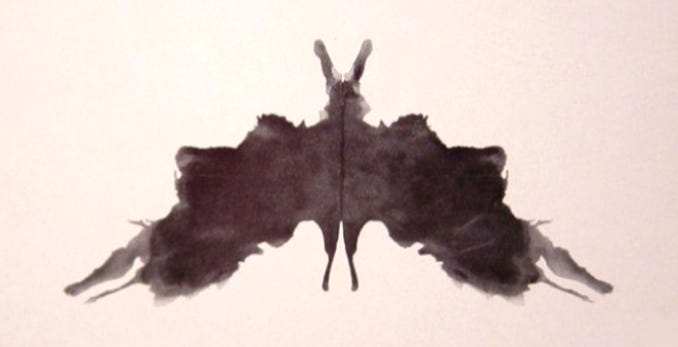
Image: Hermann Rorschach, Public domain, via Wikimedia Commons