


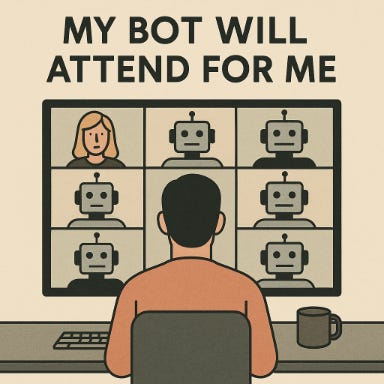
Meetings used to be just for people.
Now, they’re full of bots that record, summarize, and stay politely silent while we meatbags nod along.
So if the bots are now listening, remembering, and reporting, can we stop showing up at all? And until we can, what’s the etiquette for dealing with them?
Do Bots Break the Social Contract?
We’re used to thinking of meetings as live, shared experiences, places where presence counts, attention signals respect, and tribal norms shape how ideas are shared. Meetings aren’t just exchanges of information. They’re performances, negotiations, subtle power plays. Bots can upend the arrangement.
Sometimes, bringing meeting bots into the room is helpful. Note-taking bots can free people to focus, and private, real-time bots can offer quieter individuals advice on participating, allowing them to be heard. Other times, the presence of bots chills the room, making people more cautious, less attentive, harder to read.
Has the social contract changed? Some organizations have already decided to officially vote for the status quo. This year, the EU Council banned AI assistants from attending internal virtual meetings. Was it an overreaction? Meeting bots, when used transparently and thoughtfully, can make distributed collaboration easier.
The challenge isn’t that bots might be present. It’s that we haven’t agreed on the norms for how to use them well.
The contract is certainly evolving. And not in just one direction; our interpersonal rules don’t all break at once. But we do need some new ones.
Disclosure
If your bot shows up as a named participant, like “Rafe’s Meeting Bot,” disclosure etiquette is: you’re covered. Everyone knows there’s at least one note-taking AI capturing the conversation, and whose it is.
But some bots don’t reveal who owns them, and some aren’t visible at all. Etiquette here is straightforward, if uncomfortable: You should disclose. Your colleagues deserve to know they are being recorded. Or some teams might just come to a blanket understanding that any meeting might have one or more quiet AI flies on the wall.
If you’re ever in doubt that disclosure is necessary, try trusting your gut: If you feel like you’re getting away with something, that’s a hint you’re crossing a boundary. Speak up and clear your conscience.
Disclosure is respect. Without it, trust evaporates.
Also, there are laws about disclosing that you are recording a conversation, or even using a machine to transcribe. They vary by country and state. To be safe, each bot should be disclosed.
I will add that most recording laws were written to prevent hidden surveillance and protect the assumption of privacy. The laws assume that recording is rare, deliberate, and potentially incriminating. Meeting bots aren’t that. Recording (or machine listening) is no longer exceptional. It’s becoming ambient, and the reasons for recording are often benign. Ideally, the law wouldn’t stop at whether a recording happened, but would consider how it is used, stored, and shared.
Practically, whether or not you’re running a bot yourself, you should assume that any meeting isn’t just happening in the moment. It’s being captured, stored, and possibly analyzed. That’s the environment now.
Performance-Enhancing Bots
Some meeting bots do more than just quietly take notes: they can influence their owners’ behavior in real-time. Granola, for example, has buttons labeled “What did I miss?” and “Make me sound smart.” Then there’s the AI that is specifically designed to help you “cheat:” Cluely. These are the meeting equivalents of performance-enhancing drugs. Do we need to disclose our use of real-time bot assistance?
Announcing “my next point is enhanced by AI” every time you glance at a live analysis isn’t realistic, and AI assistance can range from minimal (live transcription) to extreme (and risky-to-use) live sentiment analysis. Again, the best practical guideline might simply be this: if your AI boost feels significant enough that you’d feel uncomfortable if others discovered it later, err on the side of transparency. Colleagues who feel they’re competing against bot-enhanced participants might feel it’s unfair, and hiding the fact that you’re bot-juicing is bad etiquette, and likely to catch up with you.
Sharing Recordings and Transcripts
When a meeting finishes, any audio or video files, and any verbatim transcripts, should be made available to all participants. But what about notes, analyses, and summaries?
Different users’ bots will create different AI outputs, and some can be heavily influenced by their users’ custom templates or personal frameworks. There’s nothing dishonest about keeping these personal insights to yourself. But we do have to recognize that this creates information asymmetry: you have aided insights that others in the meeting won’t. It’s not necessarily unfair, but it’s worth being aware of a potential technology divide. The best outcome? Everyone has the option to bring a bot, and the whole team benefits. One-sided AI use might feel like winning, but it’s poor teamwork.
Sending Your Bot Instead
The next frontier isn’t just bots taking notes, it’s bots taking meetings. They’ll be able to deliver our perspective, ask for the information we want, and participate in discussions as (we hope) reliable proxies. The etiquette rules of sending a bot in your place haven’t been written. But when they are, they won’t focus so much on equality or attendance. They will focus on accountability.
Bot or Not?
It won’t be too long before showing up to a meeting without a bot will feel like showing up without a notebook. You’ll be seen as unprepared, or just playing at a disadvantage. But we’re not there yet.
In the meantime, the guidelines in this story are, unfortunately, hard to follow in practice, and harder to enforce. Anyone can bring a bot to the meeting without saying a word.
And if you’re using a bot, you’re playing a different game than those who aren’t, and not everyone knows that yet. Whether it’s recording, summarizing, or quietly advising you mid-meeting, your bot changes how you participate. It is much more than a meeting hack.
We joke about hating meetings, but at their best, they do serve a deeper purpose. They’re platforms for connecting, collaborating, and creating shared understanding. But as we increasingly partner with AIs, or delegate our presence to them, we’re not just changing how meetings work. We are reshaping human interaction itself.
Disclosure: This article was authored by a human (me) with assistance from AI tools during the writing and editing process. All editorial decisions and final content reflect the author’s intent.