


Should you edit your text to make it sound more human?
It’s a question I think every student and professional has asked lately. Whether they are looking at a draft written entirely by AI, by themselves, or in some combination -- they are asking, “Is this enough me?”
As the Wall Street Journal’s Writers Are Going to Extremes to Prove They Didn’t Use AI, points out, clean text is suspect. It’s no longer a marker of writerly skill, but of possible mechanization. Worse, given the squishy, non-deterministic nature of how AI creates text, it’s impossible to definitively prove that a piece of writing has been written by a human. As the story says, “It’s like the new McCarthyism. People are demanding proof of something that can’t be proven.”
But this is a blog about what you should do, not what you can do or what you might get caught at. So the question stands: What’s the right amount of “you” to put in your work?
We can derive the answer by looking at the issue through two lenses. Before taking a blowtorch to your story to add some char to it, first ask,
Are you actually present in the work?
Are you being truthful about how the story was made?
Let’s look at a few cases.
Case 1: AI is the writer
If you had AI generate your text but you think it looks too much like AI (because it is) and you want people to think you wrote it, the temptation is to go in and scuff up the story, adding a subtle typo or two or changing some phrasing to match what you think human style is.
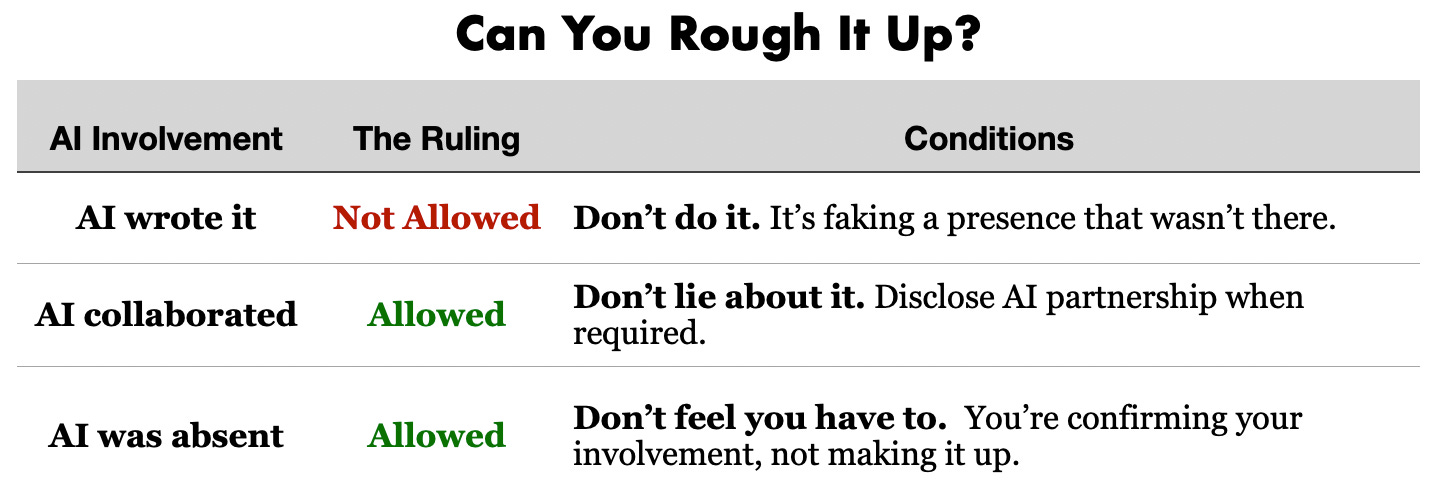
You already know: This is deception. In academic circles, it’s called cheating. You were not present for the writing, but you’re trying to paper it over to make it look like you were. If you want the story to sound more like a person wrote it, write better prompts. Participate more. Don’t lie about provenance.
Ruling: Don’t do it.
Case 2: AI is a collaborator
If you collaborated with AI to create a piece of content and it doesn’t feel enough like you, the answer to the question, “Can I go in and mess with it so it feels more like me?” is generally, “yes.” The issue is not modifying the style or tone of the text. When writing with a partner, this is always a negotiation, and as the human in this particular partnership, every editorial call is yours to make.
The question doesn’t turn on editorial manipulation to add humanity to the story. It does turn on whether you are truthful about it, and not every AI-assisted piece needs an up-front disclosure. It depends on the assignment. If the assignment specifically called for “no AI help” and you are trying to hide the fact that you worked side-by-side with it, the issue is not “should I add more me?” but “why am I hiding it?”
Ruling: Don’t lie about it.
Case 3: AI is absent
If you wrote something yourself, or with minimal AI assistance, and you’re worried that the reader or editor might think it’s actually AI because it’s too clean — too grammatical, too smooth, too technically sound — should you make it even more your own? Should you remove some of the cleanness and add “character?”
The issue here is signaling provenance, not faking it. The story is yours. It’s just a question of how much you modify it to prevent somebody from thinking it might not be.
Can you do that? Yes. Should you have to? No, but such is the world we live in.
Before AI, many professional and educational assignments asked for an invisible craftsman. Your reader didn’t want visibly hand-crafted work, they wanted skilled work. But now that machines can create imitations of what only we used to do, making yourself visible as the craftsperson isn’t sloppy, and it isn’t vanity. It is adaptation, a reasonable response to the world that stopped regarding invisibility as skill.
If your assignment was to create a high-quality story that adheres to a certain standard, and you have met that standard, you do not owe the reader or editor a pass to add burn marks that make it look “distressed” like a farmhouse-style coffee table. Why remove quality you’ve worked so hard to create?
But you would be forgiven — by me, your reader, your editor or professor, and hopefully by yourself — for making your humanity visible in text that you would have been happy to disappear in pre-AI.
I confess that I find the rise of boring AI writing oddly liberating: It frees me from the need to hew slavishly to ye olde Strunk & White. AI’s baseline of blandness opens doors of expression. It’s a small gift of permission in an increasingly oppressive medium.
Ruling: The world has changed. You can, too.
What we owe each other
I started writing this blog, Caller Calls Back, to explore how technology affects human-to-human communication. AI, a non-human communicator, adds static to this connection. It raises the noise floor of the human signal.
So it is easy to understand why a writer might scuff up their work to say, “I did this, not a machine.” The rationale, the desire to be heard above the noise, can come from pride, fear, deception, economics, even joy. But whether it is right to amplify our humanity hinges on why we do it, not on the act itself.
Image: “Zen kör” by Chery, public domain, via Wikimedia Commons.