


Do you need to say “please” and “thank you” to a voice-bot like Alexa, Siri, or Google Home?
Yes, you do. Here’s my logic. Stay with me, because I’ve been through a process to get here.
At first, I thought that being polite to machines was a dumb idea. Especially after I read Alice Truong’s story on Quartz, Parents are worried the Amazon Echo is conditioning their kids to be rude, which says that by not encouraging our kids to be polite to machines, we were in fact teaching them that it’s ok to be rude to people.
My response: Poppycock. Let’s instead teach children that people are different from machines. Let’s be sure that children know that you always have to be polite and kind to living beings. Let’s use the fact that you cannot hurt a machine’s feelings as an example of when it’s important to be good, and when it doesn’t matter.
But what if…
That was my thinking for a while, until I started to realize that these machines I was dismissing as unfeeling husks were getting smarter all the time. Interacting with an artificial intelligence will, eventually, be indistinguishable from interacting with a person, especially a person in a service role on the other end of a phone call or text chat. So, if it’s possible that you might be conversing with a human and not a machine, why not err on the side of kindness? And start doing it now, while it’s easy to train yourself, and the downside of getting it wrong is low.
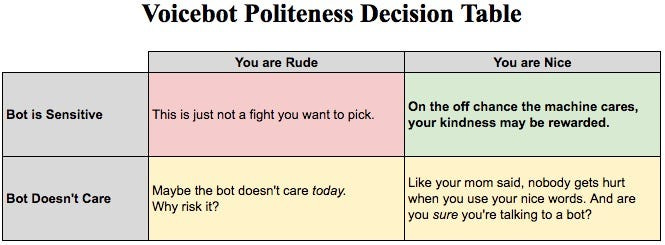
Here’s another reason to be nice to machines: If these A.I.s become sensitized to kindness, either because their programming evolves to mimic emotions or because they actually become sentient, then purely in your own self-interest, you should be nice to them. You don’t want a pissed-off United Airlines customer service bot to treat you badly because you’re being a prick. Or worse, an irate, self-driving Uber.
Start the politeness regimen today. Because all the interactions you have with Siri and Alexa today might well be stored in some giant, long-lived database somewhere, attached to your name forever. Fifteen years from now, when Siri is an A.I. with immense power and a fragile ego, you don’t want her remembering that you were a jerk back in 2017.
Or, as my 10-year-old son said, “We might as well get ready for the robot uprising now.”
Next time: How to correctly rate your Uber driver or Airbnb Host.