



If a client sends you a suggestion that’s clearly AI-generated or AI-inspired, do you have to take it seriously?
Yes, you do.
Yes really.
I remember when I received my first AI-generated draft from a client as a “suggestion” for what they wanted in the story I was writing for them. We had already had a nice conversation about the project. It was about a new kind of network architecture for data centers — a juicy topic for me to dig into. As I was putting my thoughts together and working on an outline, I got the email with the AI draft attached.
It wasn’t the worst thing I’ve seen. It wasn’t what I would write, but it landed a few points. Still, I was reflexively offended that they sent me this slop-adjacent content to “work with.”
I will bet that nearly every professional has had this experience lately. The client gives you an assignment or a case, then sends you the AI advice they came up with: the legal strategy, the website design, the plan view of the house, the op-ed draft.
Before you figure out what to do with the content you’ve been sent as a suggestion or direction, you’ve got to manage something else: yourself.
Paging Dr. Google
True story: I was once sure an odd headache I had was caused by cerebrospinal fluid leaking out of my skull and into my neck. Thank you, Google. When I told my doctor, he laughed. Fair play. I’d read dozens of pages; he’d seen hundreds of cases.
You can’t so easily laugh off Dr. Claude, though. AI does synthesis that search never could. It can be wrong, but it is also capable of great insight and, sometimes, a good imitation of creativity. When a client sends in AI advice or ideas, you have to take it seriously.
But you don’t have to take all of it. Anna Sergunina, a certified financial planner, says in a note to her clients (I’m one of them), “Please don’t bring the whole AI-generated plan, because we won’t review it... We can’t stand behind a plan built on inputs we haven’t seen.” Anna wants her clients to bring her informed questions, not work product. It’s a useful boundary. Which some clients will likely cross.
If you do get an AI plan, draft, or design, you can read it as a vision board masquerading as output. It may come from a long dialog with a chatbot in which the client said things they couldn’t concisely say to you.
Of course, it’s your name on the work. Untangling what the client wants from what the chatbot created is just part of the new AI economy — and maybe even profitable, if you bill by the hour.
The Client’s Job
Let’s also consider this from the client’s perspective, a role we will all likely fall into at some point. Say you’ve spent hours deep in it with the AI, educating yourself or working on a project for which you’ve hired professional help. Should you package up the best of the output and send it over? You know how annoyed you get when you receive unsolicited AI advice from clients. You certainly don’t want to insult your own paid practitioner.
You have the right to be informed, and to noodle on the matter at hand; in many cases you have a duty to know what your case involves. Informed consent in Western medicine says the doctor cannot decide for you; but you cannot decide either if you’re uninformed. The same can be true in law, where your decisions and actions have significant consequences. And, in fact, in any matter where money or reputation is at stake.
And yet, as a patient or client, you must leave room for your professional to do their job: exercise their experience and judgment. Use their own tools. Take the time they need to serve you in the way they know how. Your job is to bring the shoebox of ideas to the project and ask the professional for their judgment — and patience — even when the AI is whispering in your ear that you have just become a brilliant expert in their field. Because you have not.
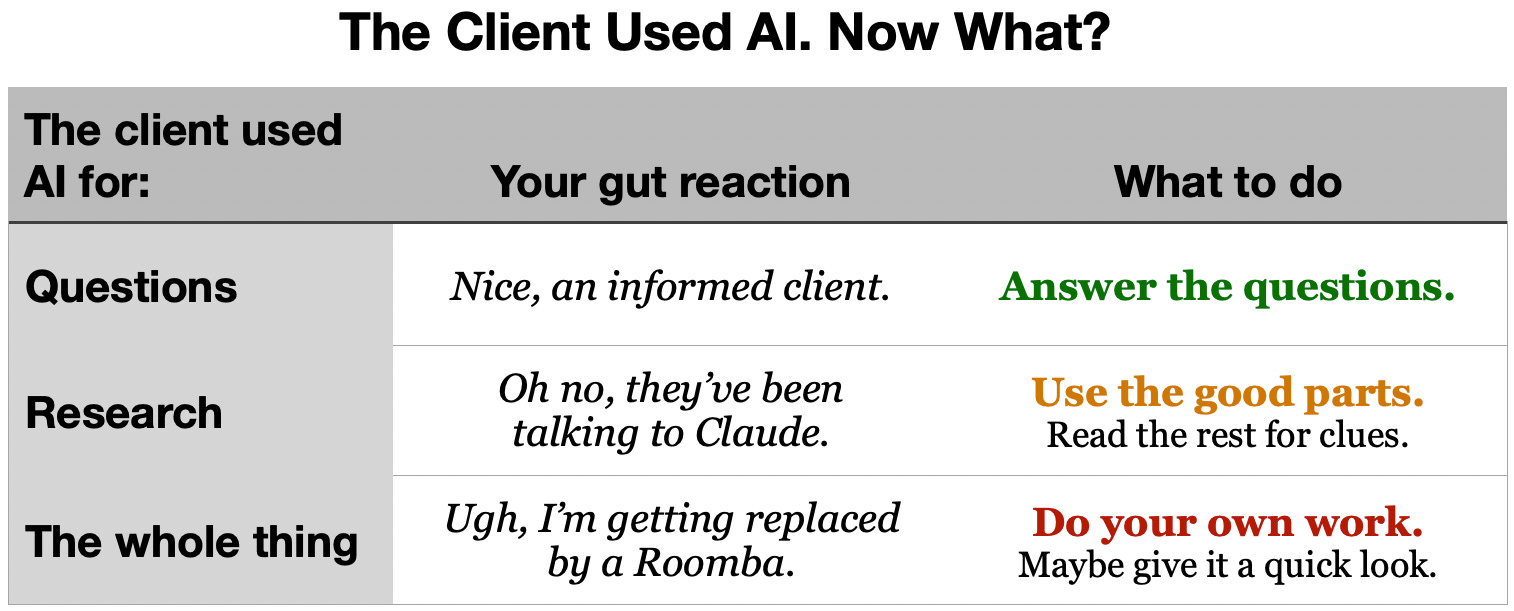
Etiquette For Sending and Receiving AI Advice
Clients, do your homework with AI and don’t feel bad about it. But communicate your questions and ideas to your professional, not AI’s raw output, even if it resembles (to you) finished product.
Professionals, read what’s sent, extract what’s useful and what the content says about your client. And don’t take it personally.
Finally, don’t expect AI’s presence to make things cheaper. Adding a know-it-all third party to the conversation can easily add time to the job, and somebody’s going to pay for it. Judgment is human, and expensive.
Photo: Berke Bayur via Pexels