


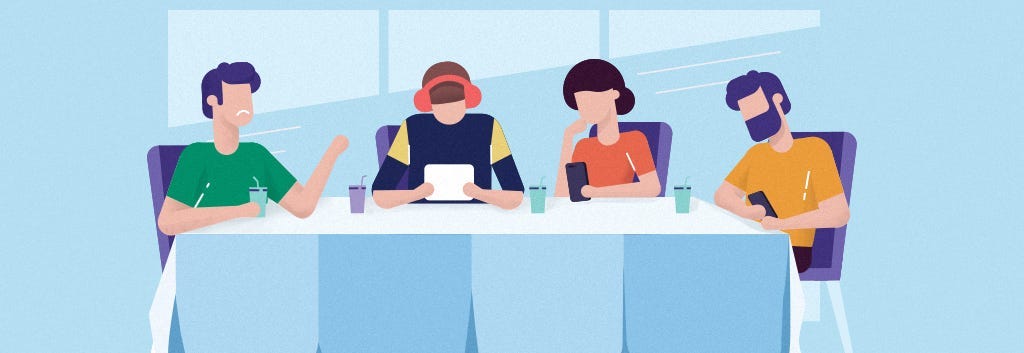
The smartphone was the worst thing to ever happen to polite dinner table conversation. Or any conversation, for that matter. Today, even when we sit down at a table for the purpose of being together, there’s always the temptation to sneak a peek at our phone. When we do this, we are sending a message to the people next to us. The message is: there is something more important to me than you are, and it’s on the other side of this little glass screen.
As your guide to etiquette in this technological age, I’ll remind you here, and not for the last time, of the impact of even small gestures, like glancing at your phone’s screen — or restraining yourself from doing so. The best way to make another person feel good is to pay attention to them. The most certain way to make them feel small is to divert your attention from them.
Pick up the conversation, not your phone
At a meal table, picking up your phone has a cascading effect. You do it, and another person will too. In a group meal, you can quickly end up with a whole table of people who sat down together for what appears to be the sole purpose of ignoring each other.
Fortunately, the same ingrate youths who are likely to pull this maneuver have also come up with a solution to it: The game of Phone Stack. While I am not in general a fan of cute games — people should be able to treat each other well without crutches — neither am in favor of people being made to feel small. Thus, my reluctant endorsement of this game.
How to play Phone Stack
It’s simple. When you sit down at the table, everyone places their phones, face down, in a stack on the table. First person to touch their phone, for any reason, picks up the check.
The accepted rulebook for Phone Stack says that if nobody has touched their phone when the check arrives, then the game ends and the check is either split or picked up magnanimously by someone, or by prior arrangement.
Alternate Play
That’s the game as it’s been known since about 2012. But like any good game, the rules can be adapted to various situations. Try these amendments, for instance:
First Down Bonus. When sitting down at the table, the first person to put their phone down is awarded a drink (or other reward), paid for by the other diners.
Family Modifier. The check-picking-up endgame was designed by young adults who, apparently, can afford to eat out a lot. But Phone Stack works just as well in a home environment. All we have to do is replace “picks up the check” with “does the dishes.”
Smartwatch Modifier. If only muzzling phones was enough to keep us focused on one another other. It’s not. Today, many of us wear watches that bother us with the same alerts that our phones do. The easy solution is for people to put their watches in their pockets, but there’s a more creative way to play the game that adds a frisson of danger: Everyone takes off their watch, gives it to the person on their left, who then wears it for the duration of the meal. When a person’s watch sends an alert, the wearer may look at it, and show it to the watch’s owner only if the alert is an emergency.
This modification will go a long way to ensuring people disable unimportant alerts on their phones before they sit down.
Jenga Penalty. If, during a meal, a phone buzzes enough to knock the tower over, the person whose phone did the buzzing immediately loses the game.
Where's the App?
For a period of time, the Malaysia branch of KFC (yes really, Kentucky Fried Chicken) pushed a branded social app that automated the game. More a marketing gimmick than anything else, it had the odd merit of fighting the fire of app addiction by providing yet another app. But I’ll give it a pass. Whatever keeps people talking to each other is a good thing.
You can also cheat, or at least get your phone to help you win. For example, your phone has a “Do Not Disturb” mode, which you can configure to automatically turn off when you leave your current location. Turn this option on when you sit down for dinner, and your phone won’t buzz during it, and you won’t be tempted to reach for it.
The Phone Stack game is years old but it’s just as important today as it was when it was invented. We’re still slaves to our little addictive glass slabs, so much so that we often ignore the flesh-and-blood slabs right next to us. This problem shows no sign of abating. Over time, the alerts might get more subtle, but it’s likely they’ll get even better at knowing how best to distract us.
Eventually, we might end up with contact lenses or even cranial implants that are pinging us with little endorphin hits that are nearly impossible to tune out. I don’t yet know what we’ll do when this happens. I do know that technology advances inexorably, and that each advance brings new tech-driven behaviors with it, that require new social coping behaviors. As your Tech Etiquette counsellor, I look forward to being here to provide guidance.